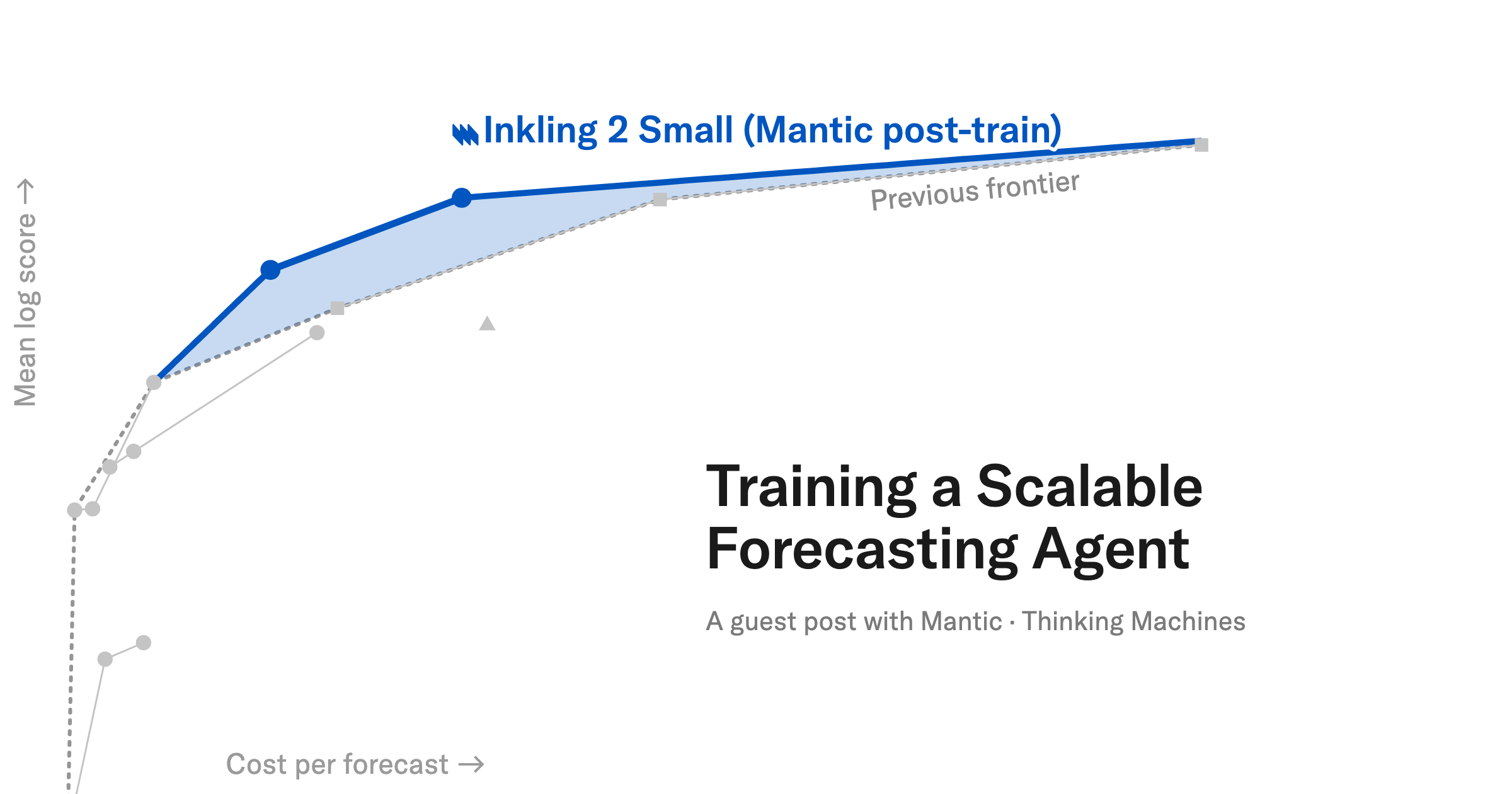
Mantic says its forecasting agent, made by further training Inkling 2 Small, roughly matches Fable 5.2 at its medium setting for one-fifteenth the cost per forecast in the team’s own evaluation. In a November 24, 2026 technical post published by Thinking Machines Lab, the team paired that claim with a suitably unsubtle demonstration: 100,000 forecasts about S&P 500 companies. Source
The comparison covers 200 numerical questions kept out of training, drawn from Metaculus, Polymarket, Kalshi and Mantic’s platform. All models ran in Mantic’s own testing setup. Prediction times were after September 15, 2026, Inkling 2 Small’s stated knowledge cutoff. The metric was mean log score, which rewards forecasts for assigning more probability weight to the outcomes that occurred. It isn’t a percentage of answers marked correct. The result doesn’t establish how the models compare on other tasks. Source
The announcement provides neither independent replication nor complete cost accounting. Source
What those 100,000 forecasts actually mean
Mantic says it generated the demonstration forecasts on November 20, targeting every S&P 500 company’s 2027 revenue and earnings per share. It produced a baseline without an assumed scenario, then forecasts for each of 50 geopolitical and economic scenarios under two assumptions: the event happens, or it doesn’t. Source
The model isn’t predicting that all 50 events will happen. The 2027 financial results aren’t in yet, so generating these forecasts doesn’t establish their accuracy. A forecast counter is not a scoreboard. Source
Teaching the agent to do the homework
The team says it used Tinker to train the agent to handle research and prediction together: look up information, execute code and submit a probability distribution showing possible outcomes and their likelihoods. To expand its training material, Mantic used language models to generate a pool of 45,000 forecasting questions from news. Those are training questions, separate from both the evaluation set and the demonstration forecasts. Source
When training on historical questions, Mantic says its research tools return only information that would have been available when the forecast was to be made. It serves that material from its own databases for faster access. No researching yesterday’s question with tomorrow’s newspaper. Source
The training method also tackles an awkward forecasting problem: an overconfident prediction can get lucky on an individual outcome. During training, Mantic says it combines scores based on actual results with scores for agreement with a reference forecast generated by several frontier models. The authors write: “The tradeoff is a bias toward the frontier models’ errors.” Source






Comments